
Pimp My Pistol: The Ultimate AR-15 Upgrade Guide
Why AR-15 Pistol Upgrades Matter
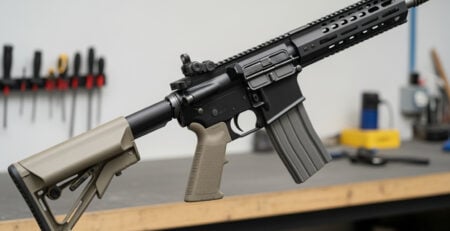
AR-15 pistol upgrades are the key to changing your factory pistol into a personalized powerhouse that fits your shooting style perfectly. The AR platform’s modularity is its greatest strength—you can swap out nearly every component to improve accuracy, handling, and reliability without needing a gunsmith for most jobs.
Most Popular AR-15 Pistol Upgrades:
- Pistol Grips – Improved ergonomics and control ($15-$114)
- Triggers – Crisper pull and better accuracy ($38-$280)
- Optics – Faster target acquisition ($40-$2000+)
- Charging Handles – Easier manipulation ($20-$143)
- Bolt Carrier Groups – Improved reliability ($120-$530)
- Handguards – Better accessory mounting ($100-$400)
- Muzzle Devices – Reduced recoil and muzzle rise ($22-$180)
- Pistol Braces – Increased stability ($299+)
With an estimated 30-40 million AR-15 pistols in the United States, the aftermarket for upgrades is massive. Whether you’re building for home defense, competition shooting, or just want a more comfortable range gun, the right upgrades make all the difference.
As one firearms enthusiast put it: “I love that I can buy one solid complete lower and have multiple guns in different calibers by simply changing out the complete upper.”
This guide walks you through the most impactful upgrades for your AR-15 pistol—from simple drop-in parts to more involved installations. You’ll learn what each upgrade does, how it improves performance, and what to expect in terms of cost. By the end, you’ll know exactly which upgrades will give you the biggest bang for your buck.
Similar topics to AR-15 pistol upgrades:
Why Upgrade Your AR-15 Pistol?
The AR-15 platform is renowned for its modularity, and its pistol variant is no exception. An AR-15 pistol, by definition, typically features a barrel shorter than 16 inches and often uses a pistol brace instead of a traditional stock. This distinction is crucial, as it impacts everything from legal classification to how the firearm handles. Upgrading your AR-15 pistol isn’t just about making it look cool; it’s about optimizing its performance, improving your shooting experience, and tailoring it precisely to your needs.
When we talk about AR-15 pistol upgrades, we’re discussing a journey to open up its full potential. A factory AR-15 pistol is a solid starting point, but with the right improvements, it can be transformed into a highly effective tool for specific purposes.
For instance, consider home defense. A compact AR-15 pistol, with its shorter barrel, is inherently easier to maneuver in tight spaces than a full-sized rifle. Upgrades can further improve this, making it more agile and responsive. For competitive shooters, every fraction of a second and every millimeter of accuracy counts. A crisp trigger, quick-acquisition optics, and superior recoil management can give you that winning edge.
Beyond specific applications, upgrades dramatically improve handling and ergonomics. We believe your firearm should feel like an extension of yourself. A comfortable grip reduces wrist stress, a smooth charging handle makes manipulation fluid, and a properly tuned gas system ensures reliable cycling. These improvements can lead to up to 45% greater accuracy, simply by making the pistol more comfortable and intuitive to shoot.
How AR-15 Pistol Upgrades Impact Performance
Every component of your AR-15 pistol plays a role in its overall performance. Changing even a seemingly small part can have a ripple effect, improving everything from reliability to shot consistency.
The barrel length is a prime example. While AR-15 pistol uppers typically feature barrels under 16 inches—common lengths being 7.5 inches and 10 inches—this choice significantly affects maneuverability and ballistic performance. Shorter barrels excel in close-quarters scenarios due to their compact size, while slightly longer pistol barrels can offer better accuracy and higher velocity for extended ranges.
The gas system is intrinsically linked to barrel length. A properly tuned gas system is vital for reliability, especially with shorter barrels and varying ammunition types. Matching the gas system (often pistol-length for AR pistols) to its intended use ensures optimal performance and prevents issues like short-stroking or excessive recoil. Components like adjustable gas blocks can fine-tune gas flow, which is particularly beneficial if you run suppressed or use different ammunition loads.
Recoil reduction and muzzle climb are critical concerns, especially with powerful calibers in a compact platform. Upgrades like specialized muzzle devices (brakes and compensators) are designed to redirect gases, significantly reducing felt recoil and keeping your sights on target for faster follow-up shots. This “fluid operation” isn’t just about comfort; it’s about maintaining control and accuracy under rapid fire.
Quality AR-15 pistol upgrades contribute to improved reliability and part durability. Investing in robust components means less corrosion, fewer malfunctions, and a firearm that stands up to rigorous use, whether you’re at the range or in a critical situation.
Customizing for Your Needs
The beauty of the AR-15 pistol is its adaptability. We can truly build a pistol that fits your specific needs, making it a personalized tool rather than a generic firearm.
Shooter preferences are paramount. Your AR-15 pistol should feel like it was made for you. This includes considering your hand size when selecting a grip, ensuring comfort and a secure hold. For left-handed shooters, ambidextrous controls—from safety selectors to charging handles—are game-changers, eliminating awkward manipulations and improving overall efficiency.
The use case scenarios for your pistol heavily influence upgrade choices. Are you building a compact firearm for home defense, where maneuverability and quick target acquisition are key? Or are you aiming for precision in competition, demanding a super-crisp trigger and stable sighting system? Perhaps it’s a truck gun or a fun range toy. Each scenario will guide your upgrade path.
Don’t forget weight distribution and balance. While sometimes overlooked, how the weight is distributed across your pistol affects how it feels in your hands, how quickly you can transition between targets, and how comfortably you can hold it for extended periods. Even seemingly minor changes, like a lighter handguard or a different muzzle device, can subtly shift the balance, ultimately enhancing your shooting experience.
The Ultimate Guide to Popular AR-15 Pistol Upgrades
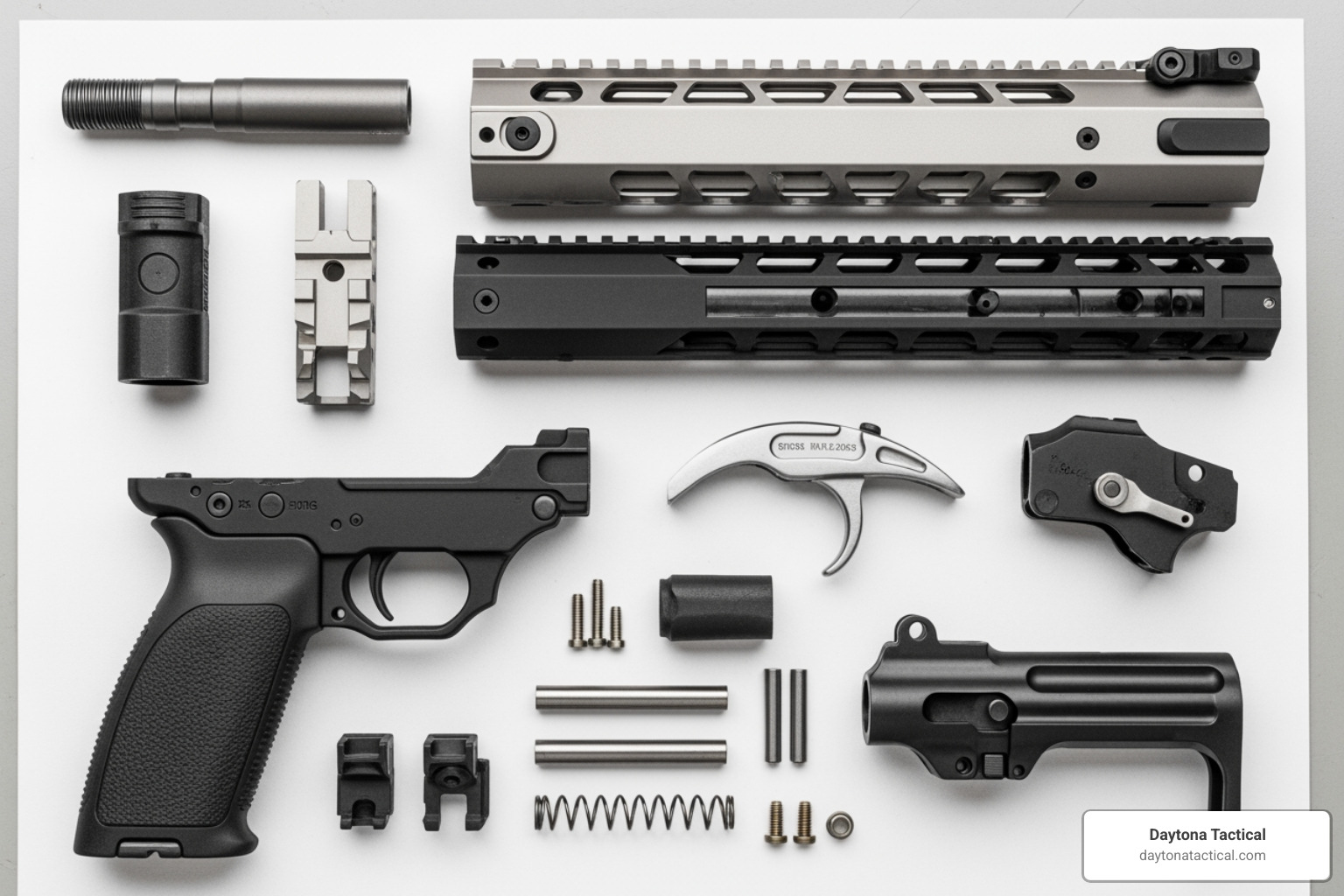
Now that we understand why upgrades are so beneficial, let’s dive into the most popular and impactful AR-15 pistol upgrades. This section will detail the most impactful upgrades, from simple swaps to more involved installations, helping you decide where to focus your efforts and budget.
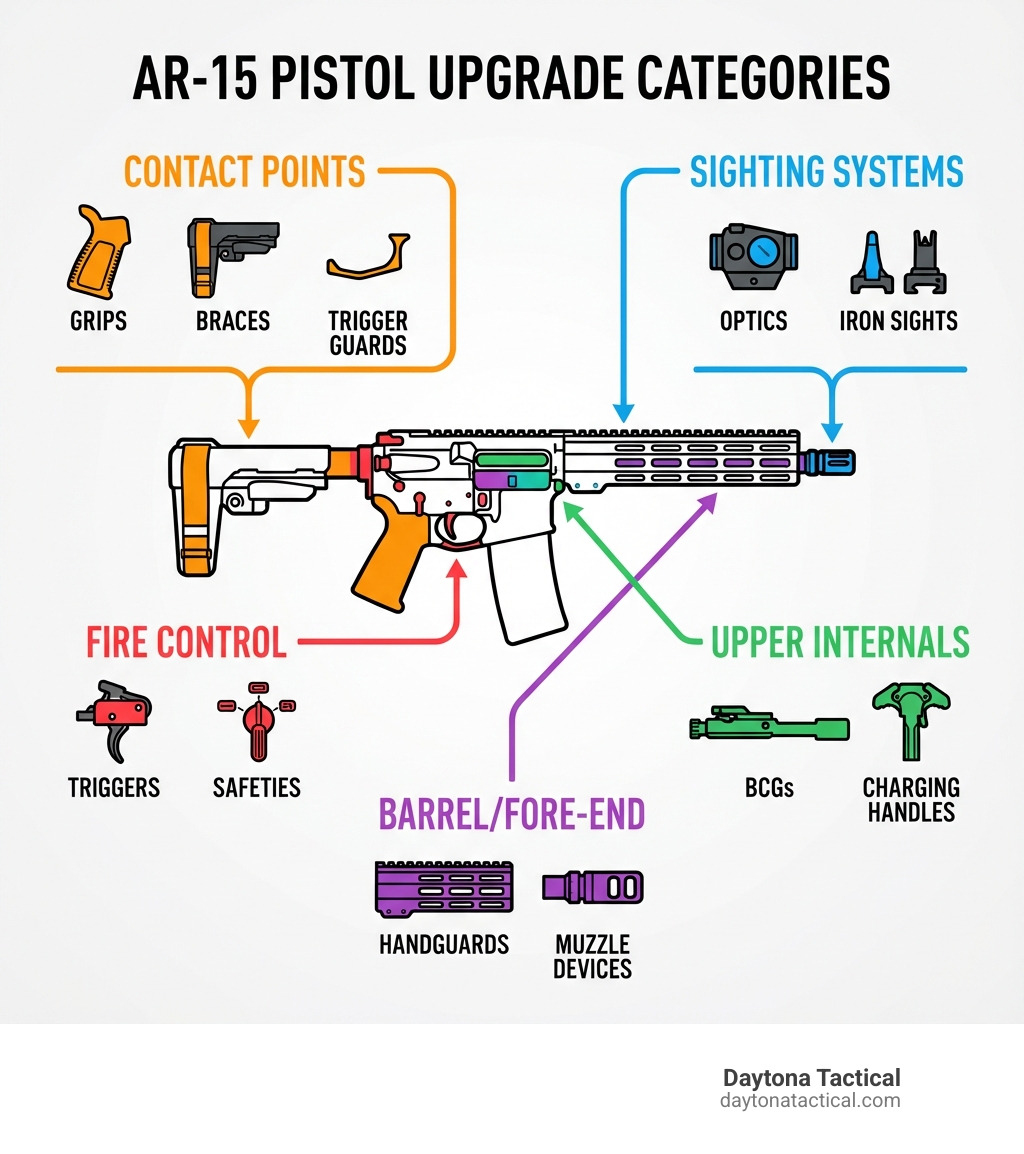
Contact Points: Grips, Braces, and Trigger Guards
These are the parts that physically connect you to your AR-15 pistol, making them crucial for comfort, control, and effective manipulation.
- Pistol Grips: A comfortable and secure grip is foundational. Upgrading your pistol grip can dramatically improve ergonomics, reducing hand fatigue and improving control. Many grips offer improved grip texture for a non-slip hold, even in adverse conditions. Some even include internal storage compartments for small tools or spare batteries. The price range for quality grips typically falls between $16 and $114.
- Pistol Braces: This is perhaps the most defining characteristic of an AR-15 pistol. Designed to aid in single-handed firing, pistol braces provide an additional point of contact for improved stability. It’s important to be aware of the changing ATF compliance rules regarding pistol braces. While recent ATF rule changes have led to legal challenges and controversy, the core principle remains: a pistol brace is not a stock, and its proper use avoids reclassifying your pistol as a Short-Barreled Rifle (SBR). For example, the SB Tactical SBPDW Pistol Brace (MSRP: $299.99) is a popular option known for its robust design.
- Enlarged Trigger Guards: For those with larger hands or who frequently shoot with gloves, an enlarged trigger guard is a small but mighty upgrade. It provides more room around the trigger, preventing accidental discharges and allowing for easier manipulation without fumbling. These tend to be quite affordable, ranging from $8 to $31.
For more insights into optimizing these critical contact points, check out this guide on 5 Great AR Pistol Upgrades.
Sighting Systems: Optics and Iron Sights
Seeing your target clearly and quickly is paramount for any firearm. Upgrading your sighting system can drastically improve your accuracy and target acquisition speed.
- Red Dot Sights: These offer rapid target acquisition and are excellent for close to medium ranges. They provide a simple, illuminated reticle that allows for fast aiming with both eyes open. Many shooters attest to their durability, noting they “stay true through re-mounting and range work.”
- Holographic Sights: Similar to red dots but with a different technology, holographic sights often provide a larger field of view and less sight occlusion, which can be advantageous for some shooters.
- Low Power Variable Optics (LPVOs): For those who want versatility, LPVOs (e.g., 1-6x or 1-8x) offer the best of both worlds: a true 1x magnification for close-quarters speed, and higher magnification for more precise shots at distance. They are a popular choice for their “versatile aiming capabilities.”
- Backup Iron Sights (BUIS): Even with robust optics, having a reliable set of backup iron sights is a smart move. They serve as a “reliable alternative if primary optics fail,” ensuring you’re never without a way to aim.
- Sight acquisition speed is a primary benefit of good optics, allowing you to get on target faster. Combined with accuracy at distance provided by magnification, and the ability to co-witness (align iron sights with your optic), a well-chosen sighting system can transform your AR-15 pistol. The price range for quality sighting systems can vary widely, from $40 for basic irons to over $2000 for high-end LPVOs.
Fire Control & Lower Parts: Triggers and Safeties
These internal components directly influence the feel and safety of your shooting experience. They might not be visible, but their impact is immediately felt.
- Drop-in Triggers: A factory trigger can often feel gritty or heavy. Upgrading to a quality drop-in trigger can provide a crisp, clean break, significantly enhancing shooting accuracy. Drop-in units are also typically easier to install than traditional components. You can choose between single-stage vs. two-stage triggers depending on your preference and the intended use of your pistol (e.g., a lighter single-stage for competition, a slightly heavier two-stage for home defense). A good trigger can make your finger “feel right at home.” Prices for these range from $30 to $280.
- Ambidextrous Safety Selectors: For left-handed shooters or those who prefer the flexibility, an ambidextrous safety selector allows for easy manipulation from either side of the firearm, enhancing versatility and speed. These typically cost between $12 and $98.
- Extended Magazine Release: In high-stress situations or competitions, every second counts. An extended magazine release provides a larger, more accessible button, allowing for quicker and smoother magazine changes. These often cost between $17 and $40.
- Anti-Rotation Pins: These small but important pins prevent your trigger and hammer pins from “walking out” during rapid fire, a common issue that can lead to malfunctions. They add an extra layer of reliability and durability, usually costing between $12 and $40.
Upper Receiver Internals: BCGs and Charging Handles
The heart of your AR-15 pistol’s cycling mechanism lies within the upper receiver. Upgrading these components can lead to increased reliability and smoother operation.
- Bolt Carrier Group (BCG): This is arguably the most critical component for your AR-15 pistol’s function. A high-quality BCG ensures reliable cycling, consistent extraction, and overall longevity. We offer various finishes like Nitride and Nickel Boron, which improve reliability and ease of cleaning by providing a slicker, more durable surface. While some call M16-style bolt carriers “full auto,” they do not make an AR-15 fully automatic; they are simply heavier and often offer better accuracy and reliability. BCGs can range from $70 to $530 depending on material and finish.
- Charging Handles: A standard charging handle can be difficult to manipulate, especially with optics mounted or when wearing gloves. Upgrading to an extended or ambidextrous charging handle, potentially with ambidextrous latches, makes for easier and faster manipulation from either side. Some designs also incorporate “gas busting” features to redirect gas away from the shooter’s face, improving comfort. These upgrades typically cost between $20 and $143.
Barrel & Fore-end: Handguards and Muzzle Devices

These components define the front end of your AR-15 pistol, influencing everything from accessory mounting to recoil characteristics.
- Free-float Handguards: A free-float handguard attaches only to the upper receiver, not touching the barrel. This design generally improves accuracy by eliminating pressure points on the barrel. Modern handguards, often featuring M-LOK or KeyMod attachment systems, provide ample space for mounting accessories like lights, lasers, and foregrips, while also aiding in heat dissipation. Handguards can range from $100 to $400.
- Muzzle Devices: This category includes Muzzle Brakes, Compensators, and Flash Hiders, each designed for a specific purpose.
- Muzzle Brakes are excellent for recoil reduction, redirecting gases backward to counteract the firearm’s rearward movement.
- Compensators primarily focus on mitigating muzzle climb, keeping the barrel flatter during rapid fire.
- Flash Hiders work to reduce the visible muzzle flash, which can be crucial for night vision or maintaining situational awareness in low light.
- Some hybrid designs, like the Mission First Tactical EvolV Brake/Compensator, use both vertical and horizontal ports to manage muzzle climb and felt recoil, while directing the concussive blast forward.
The choice of muzzle device significantly impacts muzzle blast direction and overall shooting comfort. Prices for these range from $22 to $180.
Legal Considerations and Best Practices
When starting on AR-15 pistol upgrades, it’s crucial to be aware of the legal landscape. Firearms laws, particularly concerning AR pistols, can be complex and vary significantly. We strongly advise all our customers to be “well-versed in the laws in your particular state” before making any customizations.
The ATF regulations are a primary concern, especially regarding pistol brace rules. The legal distinction between a pistol brace and a stock is critical. An AR-15 with a barrel shorter than 16 inches and a stock is classified as a Short-Barreled Rifle (SBR) under National Firearms Act (NFA) regulations, requiring a $200 tax stamp and registration. AR pistols, conversely, must maintain a barrel length under 16 inches and use a stabilizing brace (not a stock) to avoid SBR classification. Additionally, the overall length of an AR pistol is a factor; it must typically be less than 26 inches to avoid certain SBR classifications.
Recent ATF rule changes regarding stabilizing braces have led to legal challenges and controversy. It’s essential to stay informed about these developments and understand how they apply to your specific configuration.
Beyond federal regulations, state and local laws in Florida and other areas can impose additional restrictions on firearm features, magazine capacity, and even how certain components are defined. Always check with your local authorities or a firearms attorney to ensure compliance. “You can choose from various components to build a pistol that fits your specific needs,” but this customization must always be within legal boundaries. For more general information, you might find insights on Legal Aspects of Customization.
Regarding safe installation practices, we recommend the following:
- Always prioritize safety by wearing safety glasses.
- Work in a well-lit, organized area.
- Follow manufacturer instructions for each component.
- After any significant modification, perform a function check to confirm smooth operation before live firing.
Frequently Asked Questions about AR-15 Pistol Upgrades
What are the best beginner-friendly AR-15 pistol upgrades?
For those just starting their upgrade journey, we recommend focusing on parts that offer immediate improvements in handling and usability with minimal tools required.
- Grips: Easily swapped out, a new grip can immediately improve comfort and control.
- Charging Handles: A simple drop-in component, an extended or ambidextrous charging handle makes manipulation much easier.
- Sights: Mounting a red dot sight is often straightforward and offers a huge boost in target acquisition speed.
- Slings: Adding a comfortable and functional sling is easy and improves carrying and retention.
These upgrades require minimal tools and offer immediate improvements in handling and usability. Many of these can be installed by the user without a gunsmith.
What are the key differences between upgrading an AR-15 pistol versus a rifle?
The primary differences stem from the shorter barrel and the use of a pistol brace instead of a stock, which affects ballistics, gas system length, and legal classifications. When upgrading a pistol:
- Barrel Length: Pistols are defined by their short barrels (under 16 inches). Upgrades will focus on optimizing performance within these lengths, including gas system tuning for reliable cycling.
- Brace vs. Stock: Pistols use braces for stability, while rifles use stocks for shoulder firing. This is a critical legal distinction that affects component choices and compliance.
- Overall Length: AR pistols must adhere to specific overall length requirements to avoid NFA classification as an SBR.
- Ballistics: Shorter barrels will have different ballistic characteristics (velocity, energy) compared to rifle-length barrels, influencing ammunition choice and effective range.
Are AR-15 pistol upgrades legal?
Generally yes, but they are subject to federal, state, and local laws. Key areas of regulation include barrel length, overall length, and the type of brace or stock used. It is absolutely essential to “always check your local laws before modifying your rifle to ensure legal compliance,” especially here in Florida. The landscape of firearms law is dynamic, particularly regarding AR-15 pistols and accessories like braces, so staying informed is crucial. We always recommend consulting local laws or a firearms attorney before making any modifications to ensure you remain compliant.
Conclusion
As we’ve explored, AR-15 pistol upgrades is vast and exciting. From enhancing basic ergonomics with a new grip to fine-tuning performance with a precision trigger or advanced optic, every upgrade offers a chance to personalize your firearm and lift your shooting experience. The modularity of the AR platform truly allows us to create a pistol that’s an extension of your intent, whether for home defense, competition, or simply enjoying your time at the range.
At Daytona Tactical, we understand the passion behind building and customizing your AR-15 pistol. We specialize in providing an extensive selection of in-stock, ready-to-ship AR parts and accessories, ensuring you have everything you need to start on your upgrade journey.
Ready to transform your AR-15 pistol into the ultimate personalized firearm? Start your custom build with our AR-15 Pistol Build Kits today!